


 Menu
Menu
- Pre-orders(12)
- Gods of War(146)
- Gods of War: LEE(0)
- Gods of War: TOGO(146)
- Rulebooks, Starting Sets and Accessories(28)
- British Navy(17)
- Chinese Navy(6)
- French Navy(18)
- Spanish Navy(19)
- Japanese Navy(20)
- German Navy(16)
- Ottoman Navy(6)
- Russian Navy(19)
- US Navy(19)
- Transport Fleet(8)
- Martian Invasion(2)
- GAMES WORKSHOP(0)
Search
Archive
| Sun | Mon | Tue | Wed | Thu | Fri | Sat |
| 1 | 2 | 3 | ||||
| 4 | 5 | 6 | 7 | 8 | 9 | 10 |
| 11 | 12 | 13 | 14 | 15 | 16 | 17 |
| 18 | 19 | 20 | 21 | 22 | 23 | 24 |
| 25 | 26 | 27 | 28 | 29 | 30 | 31 |
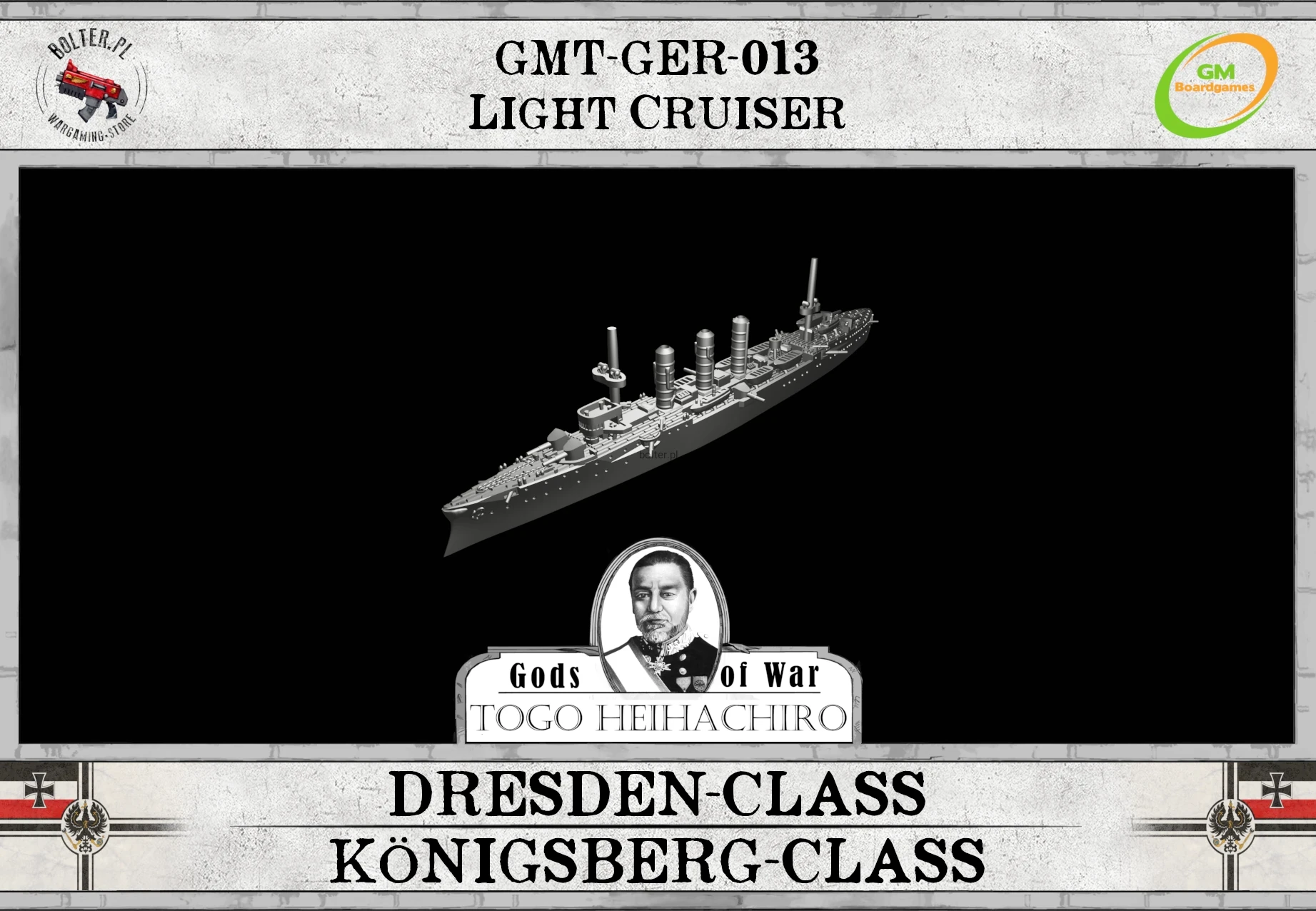
BW: Togo - German Dresden-class / Königsberg-class (Light cruiser)
 add to wish list
Description
GMT-GER-013 Dresden-class / Königsberg-class Light cruiser
Class: 3
Base length: 12 cm (included)
Colour scheme: Color scheme number 9. Asian squadron - white sides, hull and funnels yellow ochre.
Number of units per pack: 1
Number of units on the base: 1
Number of ship cards included: 2 (protective sleeve included)
The four Königsberg-class light cruisers (the subsequent ships being SMS Nürnberg, SMS Stuttgart, and SMS Stettin) were a development of the Bremen class, featuring increased speed and displacement. For this reason, they are often classified as light cruisers rather than earlier protected cruiser designs.
Ships of this class measured between 115 metres (Königsberg) and 117 metres (the remaining vessels), could reach speeds of 23 knots, and were armed primarily with ten 10.5 cm guns as well as torpedo tubes.
These ships had very eventful service careers. Königsberg carried out numerous attacks against merchant shipping in the Indian Ocean and also sank the British cruiser HMS Pegasus (of the Pelorus class) in the Battle of Zanzibar. Eventually, trapped and blockaded by the British fleet, she was sunk by two British monitors on the Rufiji River. Nürnberg took part in the Battles of Coronel and the Falklands, where she was sunk. The remaining two ships served very actively in the North Sea, including participation in the Battle of Jutland.
Although these cruisers are not particularly heavily armed (typical for German designs), their speed and torpedo armament can compensate for any shortcomings in artillery power, making them a very significant reinforcement for the German fleet.
-------------------
The Dresden-class light cruisers (the second ship being Emden), which entered service from 1908 onward, were slightly enlarged and faster successors to the Königsberg class, although they retained the same armament — ten 10.5 cm guns, eight lighter guns, and two torpedo tubes. Their speed reached an impressive 24 knots.
Both ships measured approximately 118 metres in length and displaced over 3,500 tons.
After completion, both vessels were assigned to the German East Asia Squadron.
Dresden took part in the Battles of Coronel and the Falklands, where she was the only German ship to escape destruction. Hiding among the Chilean islands, she was eventually hunted down near Más a Tierra and sunk by British cruisers, including HMS Glasgow, against which Dresden had fought at Coronel.
Emden, meanwhile, began the war at Qingdao, from where she was sent on a raiding campaign into the Indian Ocean. During the attack on Penang, she sank the Russian cruiser Zhemchug (which had survived the Battle of Tsushima in 1905) and the French destroyer Mousquet. Later, during the Battle of the Cocos Islands, the Australian cruiser HMAS Sydney forced Emden to run aground.
Although their artillery armament was not especially powerful for ships of this class, their excellent torpedoes and high speed would become major advantages for commanders of the German Navy.
The models in the set are resin, 3D printed and can be damaged if not handled properly. All models are unpainted. Glue and paints are not included. Contains small parts and is not intended for use by children under 14 years of age.
Instructions on how to prepare models for painting can be found here:
http://www.gmboardgames.com/blog/en/how-to-prepare-3d-printed-models-for-painting/