


 Menu
Menu
- Pre-orders(12)
- Gods of War(146)
- Gods of War: LEE(0)
- Gods of War: TOGO(146)
- Rulebooks, Starting Sets and Accessories(28)
- British Navy(17)
- Chinese Navy(6)
- French Navy(18)
- Spanish Navy(19)
- Japanese Navy(20)
- German Navy(16)
- Ottoman Navy(6)
- Russian Navy(19)
- US Navy(19)
- Transport Fleet(8)
- Martian Invasion(2)
- GAMES WORKSHOP(0)
Search
Archive
| Sun | Mon | Tue | Wed | Thu | Fri | Sat |
| 1 | 2 | 3 | ||||
| 4 | 5 | 6 | 7 | 8 | 9 | 10 |
| 11 | 12 | 13 | 14 | 15 | 16 | 17 |
| 18 | 19 | 20 | 21 | 22 | 23 | 24 |
| 25 | 26 | 27 | 28 | 29 | 30 | 31 |
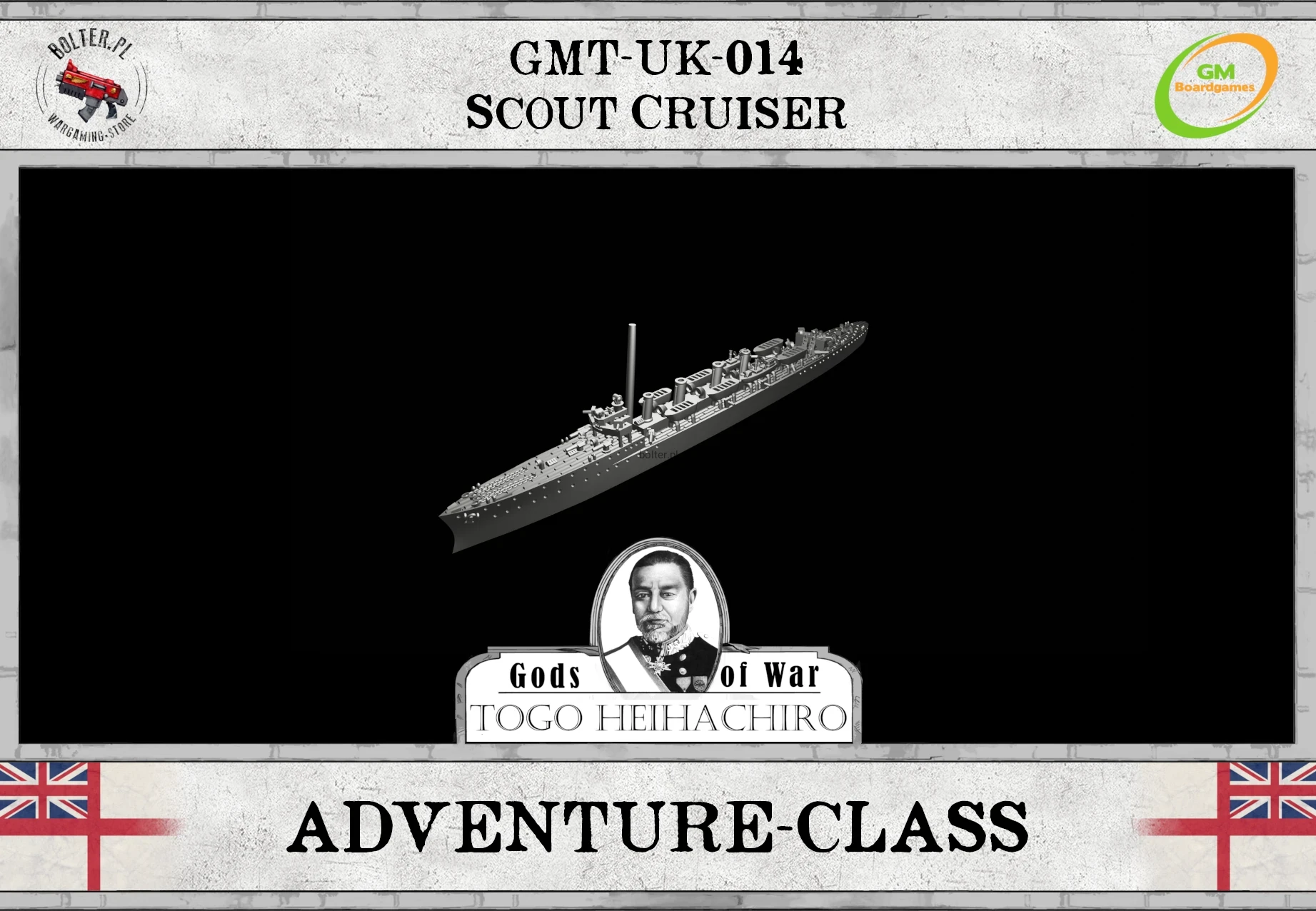
GoW: Togo - British Adventure-class (Scout cruiser)
 add to wish list
Description
GMT-UK-014 Adventure-class (Scout cruiser)
Class: 3
Base length: 12 cm (included)
Colour scheme: Victorian or standard British wartime.
Number of units per pack: 1
Number of units on the base: 1
Number of ship cards included: 1 (protective sleeve included)
In the early 20th century, it became increasingly clear in the United Kingdom that the main rival would not be France (with whom a cordial agreement had been signed), but Kaiser’s Germany.
This led to a growing focus on the North Sea as the key theatre of operations in the upcoming war. At the same time, continuous technological advancements meant that destroyers were becoming larger and capable of operating in increasingly rough seas (starting from the River class). However, these vessels were still too small to serve as comfortable ships for a squadron commander, not to mention carrying the increasingly popular radio transmitter with the necessary power. As a result, there was a need for the creation of vessels that would lead destroyer squadrons, with the main task of the team being long-range reconnaissance for the fleet (it was concluded that a classic blockade along the coasts of Germany, in the style of the 19th century, was impossible) and potential torpedo attacks.
Unfortunately, the previously built protected cruisers were too slow for this role. Even the latest ships of the Challenger and Topaze classes could only achieve 21-22 knots, far too slow to operate alongside destroyers. Not to mention the fact that the HMS Dreadnought, introduced in 1906, was expected to reach the same speed. Therefore, the new ships had to be significantly faster. This gave rise to the concept of the Scout Cruiser.
The Royal Navy ordered eight ships of this class, specifying their requirements but allowing four selected contractors to build the vessels. One of these, built by Armstrong Whitworth’s shipyard in Elswick, was the HMS Adventure (the second ship of the HMS Attentive class). Both ships were commissioned at the end of 1905. They could reach a speed of up to 25 knots and were armed with ten 12-pounder (76 mm) guns, eight 3-pounder (47 mm) guns, and two torpedo tubes. They displaced just over 2,600 tons.
It soon became clear that their armament was insufficient, and in 1906, a rearmament was carried out. The 47 mm guns were removed, and two additional 12-pounder guns and six 57 mm guns were added.
The Adventure class stood out from the other concurrently built scout cruisers with its distinctive four-funnel silhouette. All the ships had very sleek shapes, which helped them reach the required speed of 25 knots.
Besides speed, the high manoeuvrability of this ship made it particularly suited for its role as a leader of a destroyer flotilla. It would also be very useful in combating torpedo vessels or in all scenarios where reaching or leaving a distant point is scored.
The models in the set are resin, 3D printed and can be damaged if not handled properly. All models are unpainted. Glue and paints are not included. Contains small parts and is not intended for use by children under 14 years of age.
Instructions on how to prepare models for painting can be found here:
http://www.gmboardgames.com/blog/en/how-to-prepare-3d-printed-models-for-painting/